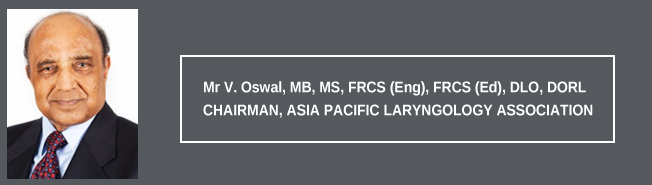
Laryngology in the twenty first century : A message from Founder Chairman, Mr Vasant Oswal, UK
Manuel Garcia, a singing teacher is considered to be the first individual to view the functioning glottis in its entirety in 1854.
He developed a tool that used two mirrors for which the sun served as an external light source. Garcia was able to observe his own functioning vocal cords and the upper segments of his trachea.
His findings were presented at the Royal Society of London in 1855. Literature on the net is full of historical landmarks noting various refinements in the quest of anatomical and physiological assessment of the larynx as an outpatient procedure.
However, it is noteworthy that, while the humble mirror remained the indirect laryngoscope for over a century, the major impact to the advancement of Laryngology has to be the source for bright illumination.
Sunlight was replaced by candle light, which in turn was replaced by incandescent electric bulb following its invention by Thomas Edison in 1879. During my residency in 1960, I wore a head mirror with a head band.
A light beam from Bulls eye lamp was focused on to the head mirror. By suitably adjusting the head mirror, the beam was reflected towards the patient. A small ‘laryngeal’ mirror was warmed on a spirit lamp to prevent fogging.
The tongue was pulled out with one hand to expand the oropharynx and the laryngeal mirror was placed in the oropharynx. The beam from the head mirror illuminated the laryngeal mirror, which in turn illuminated the larynx.
After checking any pathology affecting the larynx, patient was told to say ‘eee’. This resulted in movement of the cords towards the midline. Any impairment in full adduction was noted. Since the view of the larynx was a mirror image, the procedure was called indirect laryngoscopy.
Topical anaesthesia was necessary in some patients with active gag reflex. The only ‘therapeutic’ application of indirect laryngoscopy was for removal of fish bone stuck in pyriform fossa or in the posterior third of the tongue.
This required dexterity and also some skill acquisition, since the view was a mirror image and movements of forceps to catch the bone needed to be in opposite direction, as seen in the mirror! Some older agile surgeons also took biopsy of cancerous mass in the larynx, in the outpatient.
Medical field is a fertile ground for embracing technological advances. Since my days as resident in the sixties, there have been enormous inroads in the Laryngology, both in the office setting and in the operating theatre.
Ever-increasing knowledge of vocal fold anatomy and physiology has seen a quantum leap in the clinical and surgical practice of Laryngology. An all-important shift has taken place from a mere removal of disease, to preservation of laryngeal functions –protection of airway, respiration, phonation and swallowing.
Transoral surgery for laryngeal lesions is now first line standard management for all benign and early glottic lesions. High energy devices such as laser, RF, micro-debriders have ensured that preservation of laryngeal function remains focussed.
Use of hi-tech equipment, both in office setting and in the theatre has identified challenging training requirements away from the patient, in a physical simulation set-up of a lab.
Past decade saw explosion in teaching courses in Laryngology. With so much more that can now be done in the larynx transorally, more and more surgeons are choosing Laryngology as their subspecialty.
Others, engaged in general ENT practice want to learn more in Laryngology to offer a better surgical outcome for their patient population. Laryngology as super (or sub) speciality has come of age. It is little wonder therefore, that increasing number of courses and conferences, dedicated to Laryngology alone have found a larger clientele. Likewise, a number of professional organisations solely for the science and art of Laryngology have also been established.
Laryngology Voice Association (LVA) is one such organisation which was established in 1995 in India. Since 2012, it has held annual conferences and courses in various metropolis cities in India. The last one (2017) was held in Bangalore, with an attendance of 350 ENT professionals from US, UK, Japan, Singapore, Iraq, Egypt, Philippines, Bangladesh and of course, India.
Asia-Pacific region represents diverse socio-economic countries. While some nations have advance technology in a dedicated Laryngology set-up, particularly in metropolis, others remain rudimentary by today’s standard. A bold initiative was proposed under my Chairmanship and Dr Sachin Gandhi’s Presidency, to enlarge the scope of the science and art of Laryngology for a wider audience in the Asia-Pacific countries. A unanimous vote of some 35 participants present at the meeting, ensured that the proposal was worthy of further exploration. In addition, some countries’ leading surgeons, who could not be present in Bangalore, were also supportive. This group of participants were voted to be founding members of Asia-Pacific Laryngology Association (APLA). A working party was established to deliberate the various aspects of forming the umbrella body in the name APLA, with membership of existing national Laryngology associations in the region. Although the new Association has intonation of geographical area (Asia-Pacific), for the purposes of the professional organisation, geographical boundaries should not count and any individual, laryngology interest groups or Laryngology Societies are welcome to become member, irrespective of their geographical location.
This website is therefore a precursor of what is to follow in substance, and readership of this website in invited to send comments to the contact tab, you are very much welcome.

It gives me immense pleasure to launch the official website of Asia-Pacific Laryngological Association (APLA). I consider it an honour to be the President of the Association, and uniting the laryngologists of the Asia-Pacific region.
The main objective of forming this association is to promote exchange of knowledge, research and training in laryngology in the Asia-Pacific region. APLA will thus collaborate with Courses and Conferences dedicated to Laryngology, thus exposing them to a much wider audience in the Asia-Pacific region and further afield. It will also encourage designated APLA sessions within the general annual ENT conferences, thus enriching the scientific programme with a wider participation.
The 1st APLA Congress will be held in under the auspices of APLA in Singapore in 2019, followed by 2nd APLA Congress is proposed in Pune, India, in 2021.
Finally, let me conclude by thanking all of you for your support and we look forward to the continued support and active involvement of the entire membership to carry out our activities in future.
Chairman:
Dr Vasant Oswal – UK
President:
Dr Sachin Gandhi – India
Vice Presidents:
Dr Paul Castellanos – USA
Dr David Lau – Singapore
Dr Kamrul Hassan Tarafder – Bangladesh
Dr SM Khorshed Alam Mazumdar – Bangladesh
Dr Ichiro Tateya – Japan
Coordinating Committee:
Dr Shashank Gupta – India
Dr John Hector Pagdanganan – Philippines
Dr Rohan Bidaye – India
Dr Ahmed Elsobky – Egypt
Secretary General:
Dr Navin Patel – India
Treasurer:
Dr Nilanjan Bhowmick – India
Bangladesh
Dr. Kamrul Hassan Tarafder
Egypt
Dr. Ahmed Elsobky
India
Dr. Navin Patel
Dr. Shashank Gupta
Dr. Rohan Bidaye
Dr. Sachin Gandhi
Dr. Nilanjan Bhowmick
Iraq
Dr. Basim Yas
Japan
Dr. Ichiro Tateya
Jordan
Dr. Ahmad Al Omari
Oman
Dr. Rajan Cherian
Philippines
Dr. Rodel Velasquez
Dr. John Hector Pagdanganan
Russia
Dr. Sergei Karpischenko
Singapore
Dr. David Lau
Srilank
Dr. Devanand Jha
UK
Dr. Vasant Oswal
Dr. Guri Sandhu
USA
Dr. Paul Castellanos
Dr. James Thomas
Bangladesh
Dr. Kamrul Hassan Tarafder
Dr. S M Khorshed Alam Mazumdar
Egypt
Dr. Ahmed Elsobky
India
Dr. Dev Roy
Dr. Ashok Purohit
Dr. Thirunavukarassu
Dr. Monark Shah
Dr. SuhelHasan
Vrushali Desai
Dr. Nilanjan Bhowmick
Dr Manish Munjal
Dr Neha Sood
Dr. Rohan Bidaye
Dr. Sachin Gandhi
Dr. Navin Patel
Dr. (Brig.) WVBS Ramalingam
Dr. Rakesh Datta
Dr. Sachin Nilakhe
Dr. Dinesh S
Dr. Amit Anand
Dr. Bharathi MB
Hemant J Patel
Dr. Krishnamurthy N
Dr. Anurag Ramavat
Dr. A Ravikumar
Dr. Manjunath MK
Iraq
Dr. BasimYas
Japan
Dr. Masahiro Tanabe
Dr. Ichiro Tateya
Dr. Shinya Hiroshiba
Jordan
Dr. Ahmad Al Omari
Oman
Dr. Rajan Cherian
Philippines
Dr. Rebecca R Feliciano
Dr. Paula Sigma Javier
Dr. John Hector Pagdanganan
Russia
Dr. Sergei Karpischenko
Srilanka
Dr. DevanandJha
Singapore
Dr. David Lau
UK
Mr. Vasant Oswal
Dr. Guri Sandhu
USA
Dr. Paul Castellanos
Dr. James Thomas
India
Brig (Dr.) WVBS Ramalingam
Dr. Dev Roy
Dr. Ashok Purohit
Dr. Rakesh Srivastava
Switzerland
Dr Kishore Sandu
UK
Prof. Paul O’Flynn
Dr Guri Sandhu